

Open-source AI, indexed and scored
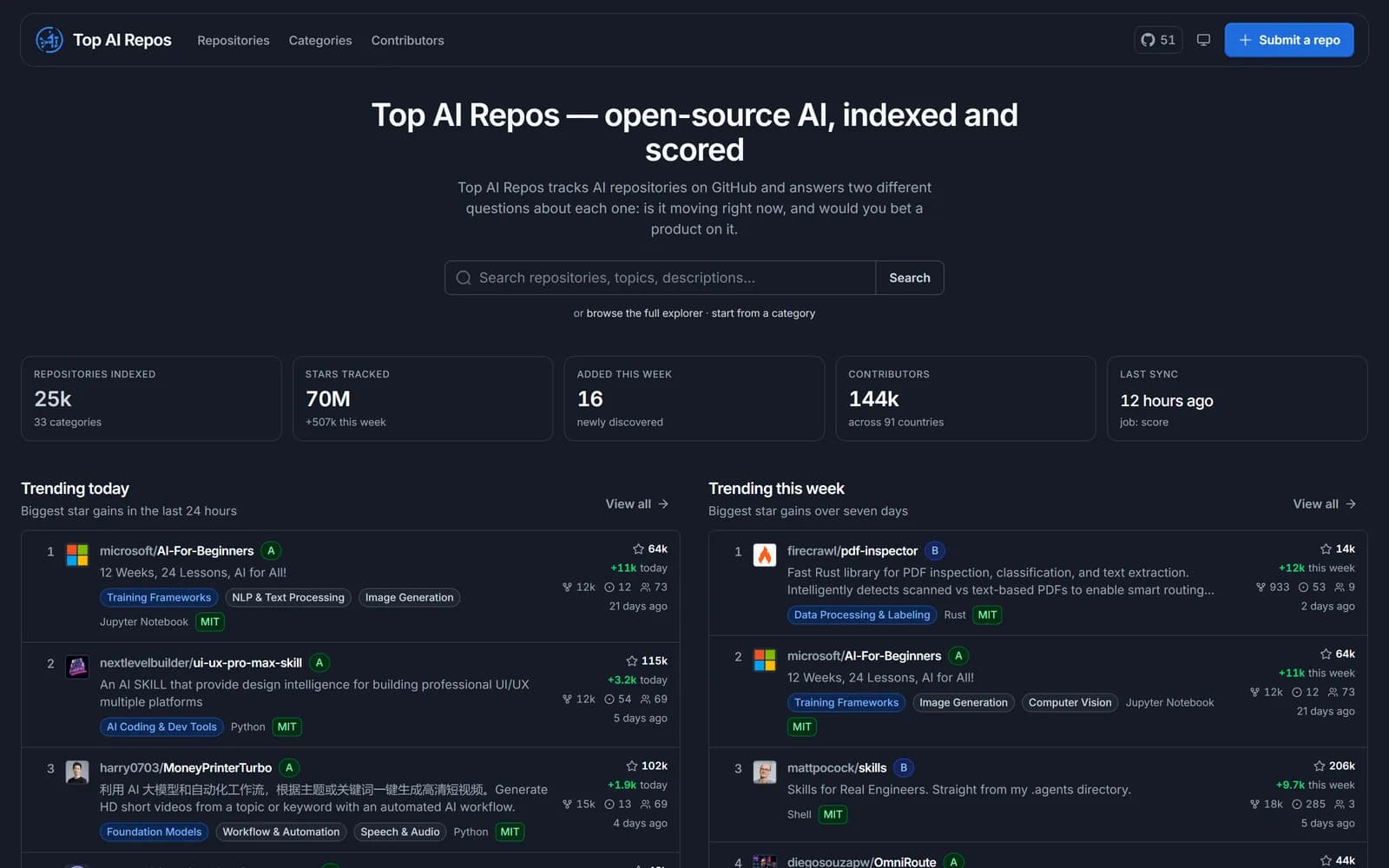
A platform tracking more than 25,000 AI repositories on GitHub, answering two separate questions about each one: is it moving right now, and would you bet a product on it.
- Role
- Creator and maintainer
- Type
- Open-source platform
- Licence
- Apache 2.0
- Refresh
- Daily pipeline
- Repositories indexed
- 25k+
- Stars tracked
- 70M
- Contributors mapped
- 144k
- Countries represented
- 91
A star count is a lifetime total, not a signal.
Stars accumulate and never decay. A repository with 40,000 stars and no commit in eight months outranks one with 3,000 stars shipping weekly releases, even though only one of them is alive.
In AI that gap is brutal, because projects go from essential to abandoned inside a year. Worse, a single number is being asked to answer two unrelated questions at once: what is moving right now, and what is safe to build on.
- Popularity treated as a proxy for health
- No way to see momentum separately from reliability
- A fast-moving field measured with a cumulative metric
Momentum and durability are measured separately.
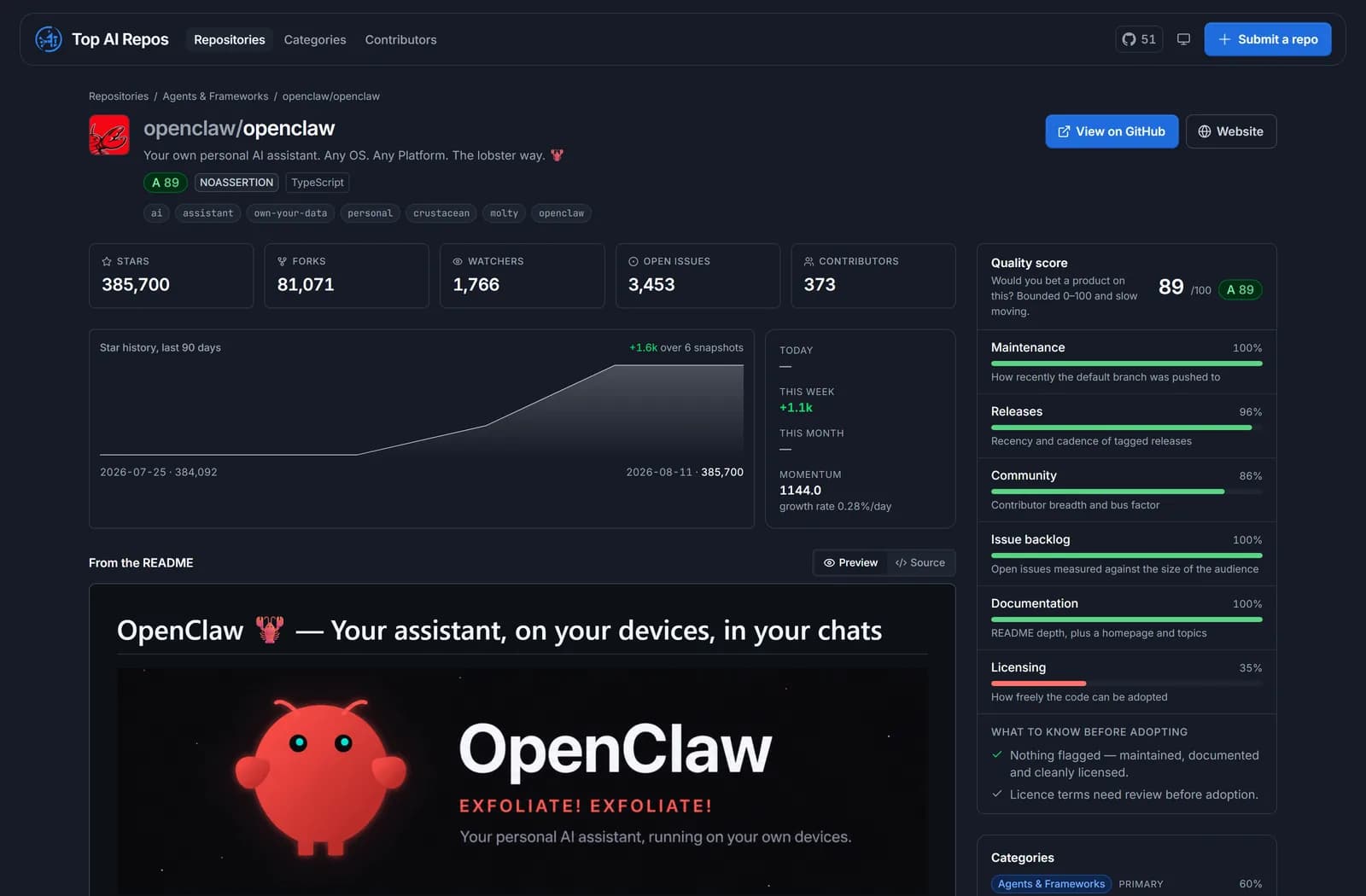
The Trend score is unbounded and comparative. It reads daily and weekly star growth, contributor expansion, and release recency, and it answers the question of what is happening now.
The Quality score is bounded from 0 to 100 with a letter grade, and it answers whether you would bet a product on this. It breaks into six visible signals, maintenance, releases, community, issue backlog, documentation, and licensing, so the score is a starting point for a decision rather than a verdict you have to trust.
- Trend score: growth, contributor expansion, release recency
- Quality score: six weighted signals, shown individually
- Every score expands into the evidence behind it
An index nobody can browse is just a database.
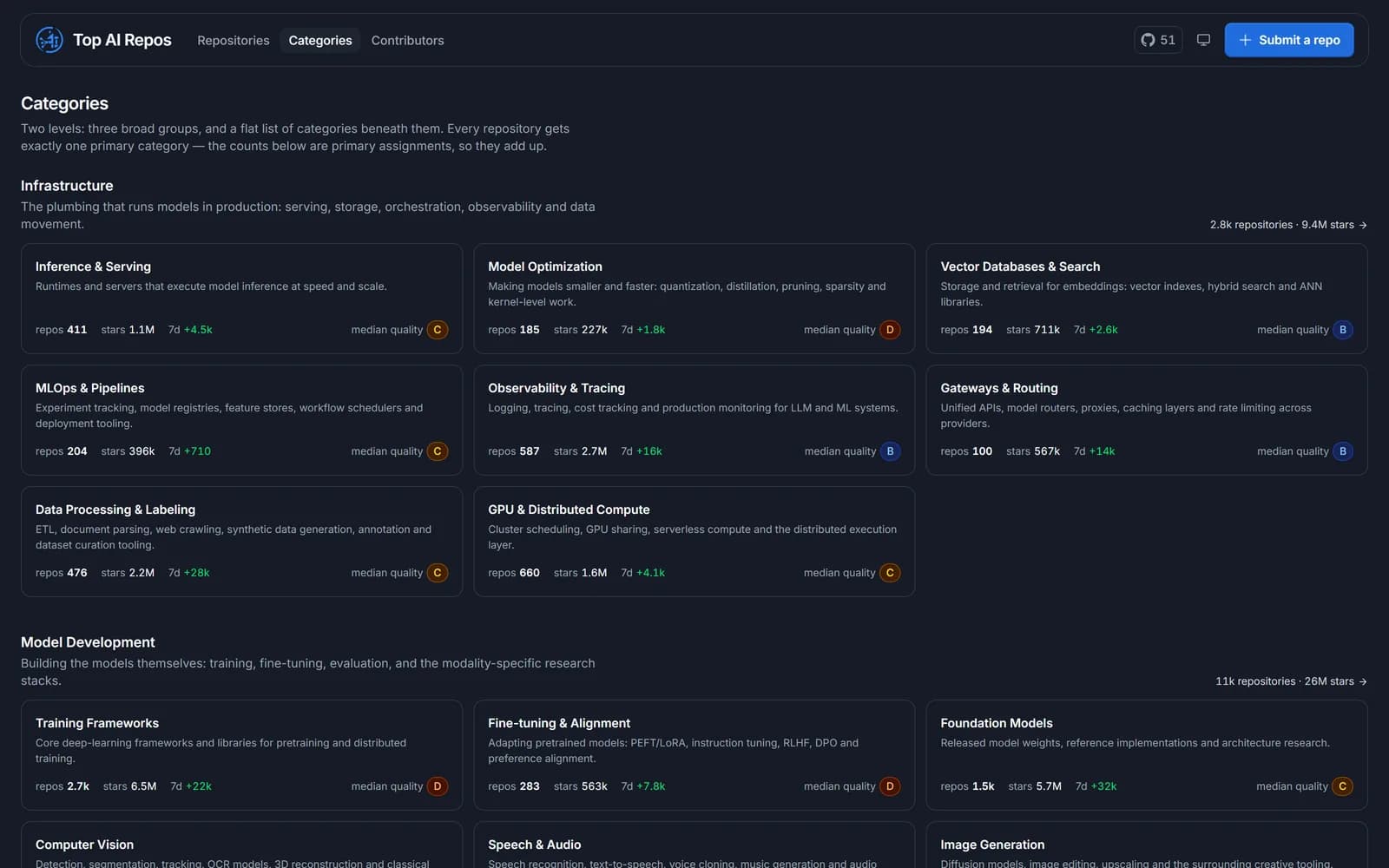
Three broad groups, infrastructure, model development, and application development, sit above a flat list of 33 categories. Every repository gets exactly one primary category, so the counts add up and nothing is double-counted across the taxonomy.
Classification is rules-first, with an LLM used only as a fallback for what the rules cannot place. Each category carries its own repository count, star total, weekly movement, and median quality grade, so a category page is a genuine answer rather than a filtered list.
Filter state lives in the URL, not in memory.
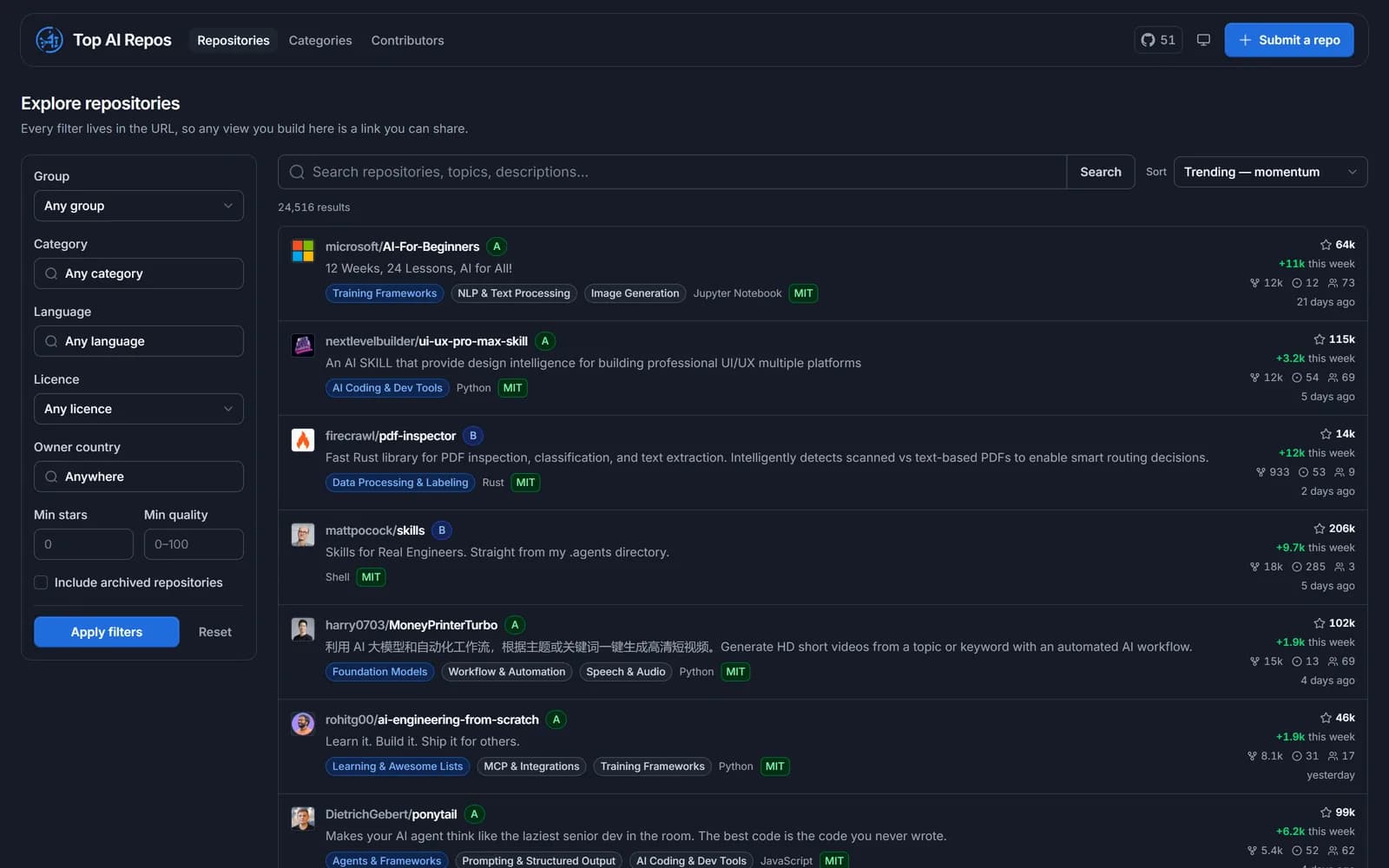
Group, category, language, licence, owner country, minimum stars, and minimum quality all serialise into the URL, so every view you build is a link you can send to someone. Nothing is trapped in component state.
Filtering runs server-side across the full 24,000-plus result set, with incremental static regeneration and in-process query caching keeping the common views fast rather than recomputed.
- Every filter combination is an addressable, shareable URL
- Server-side filtering across the whole index, not a page of it
- ISR plus query caching for the views people actually open
Ranked by breadth, not by commit count.
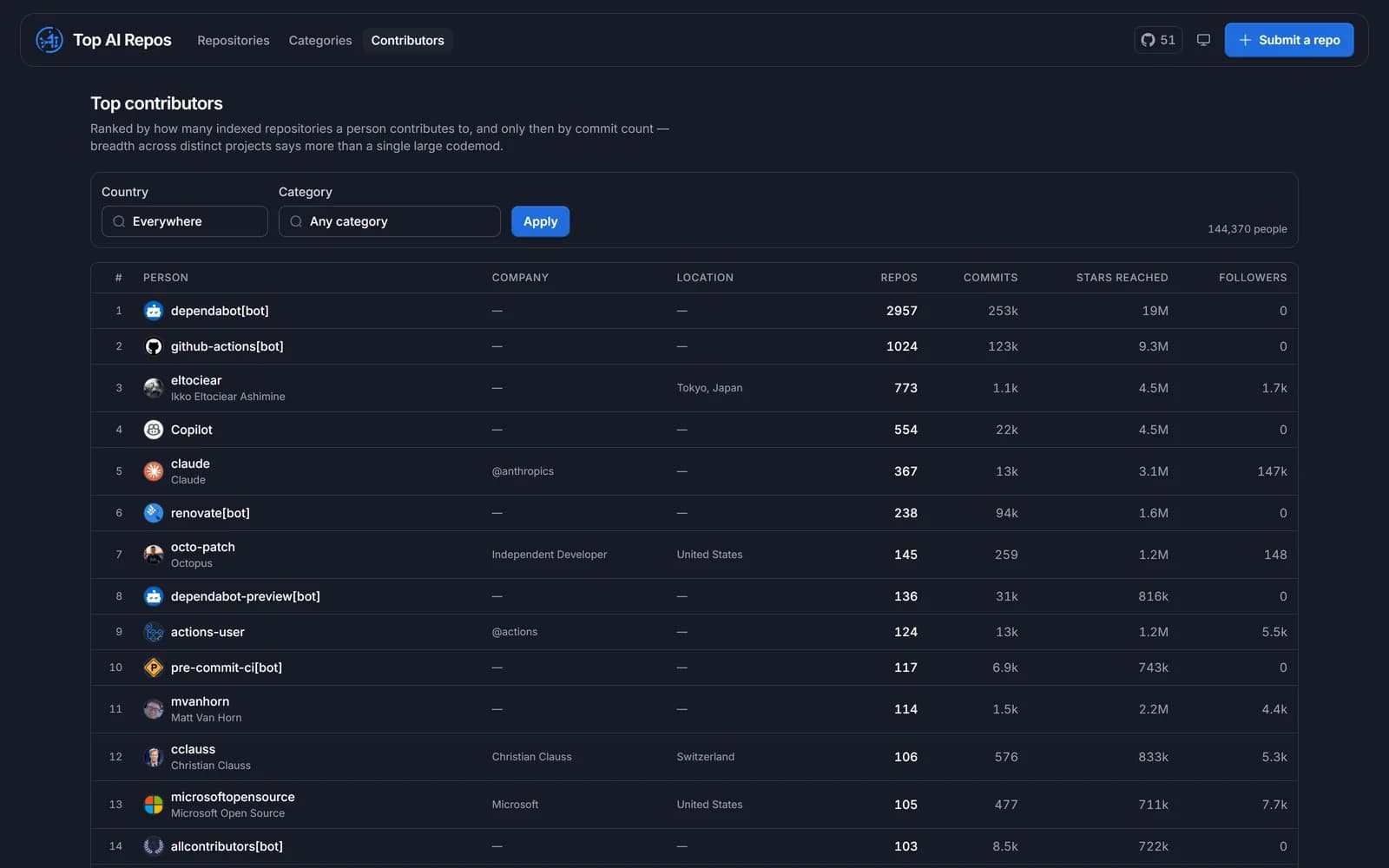
The contributor leaderboard covers 144,370 people across 91 countries, ranked first by how many indexed repositories a person contributes to and only then by commits. Breadth across distinct projects says more about influence than one large codemod does.
Country and category filters make it possible to ask narrower questions, like who is actually building inference tooling, and where.
An index that stays honest about what is alive.
An eight-stage daily job discovers, syncs, snapshots, resolves countries and contributors, classifies, and scores. Stage order is load-bearing: snapshots are taken before the contributor stage so history can never be silently rewritten.
Storage is change-only, which collapses roughly 29,000 daily rows to about 1,800. The index stays current, the history stays trustworthy, and the whole thing stays cheap enough to run every day.
What we built it with
Production-proven tools chosen for performance, developer velocity, and long-term maintainability.
Next.js
TypeScript
PostgreSQL
Drizzle ORM
React Aria
Tailwind CSS
GitHub API
Vercel


What shipped
- 25,000-plus repositories indexed and refreshed daily
- Separate trend and quality scores, each broken into its signals
- 33 categories with single primary assignment, so counts add up
- Every filtered view addressable as a shareable URL
- Contributor graph across 144,370 people and 91 countries
- Change-only storage, cutting 29,000 daily rows to about 1,800
Want results like these?
Book a free 30-minute call. We'll scope your project, recommend the right approach, and tell you honestly if we're the right fit.